
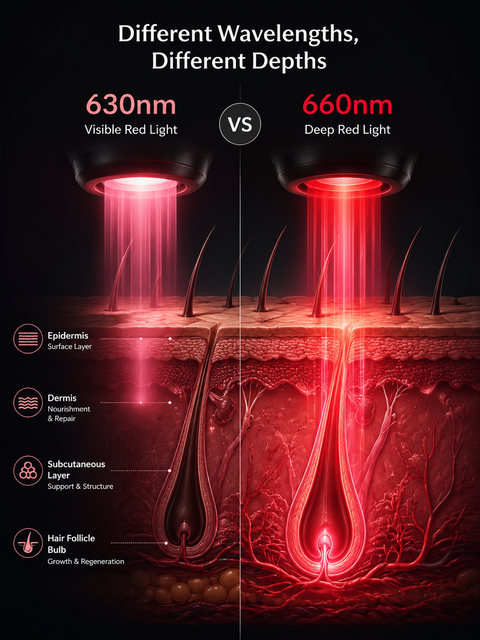
660nm vs 630nm Red Light Therapy: Which Wavelength Is Best for Hair Growth?
If you've been researching red light therapy devices for hair growth, you've probably noticed that different products advertise different wavelengths -- most commonly 630nm and 660nm. Both fall within the red light spectrum. Both are used in LLLT (low-level laser therapy) devices. But they are not the same, and the difference matters more than most brands will tell you.
This article explains what the science says about each wavelength, why 660nm has emerged as the preferred standard for scalp and hair health specifically, and what to look for when evaluating a red light therapy device.
Understanding Light Wavelengths: A Quick Primer
Light wavelength is measured in nanometers (nm) and determines how deeply light penetrates tissue. In general, longer wavelengths penetrate more deeply. Within the red light spectrum (roughly 620-700nm), the difference between 630nm and 660nm is 30 nanometers -- small in absolute terms, but meaningful in terms of tissue penetration and biological effect.
Both wavelengths are absorbed by mitochondria inside cells, triggering increased ATP (adenosine triphosphate) production -- the cellular energy that powers repair, growth, and regeneration. But the depth at which this happens, and which tissues are most affected, differs between the two.
630nm: Surface-Level Red Light
The 630nm wavelength penetrates to approximately 1-2mm beneath the skin surface. This makes it effective for:
- Superficial skin rejuvenation
- Wound healing at the skin surface
- Reducing fine lines and improving skin texture
- Treating surface-level inflammation
For these applications, 630nm performs well and has solid clinical backing. However, hair follicles in the scalp are located in the dermis -- approximately 3-5mm below the surface, with some follicles reaching 8-10mm deep. At 630nm, the light simply does not reliably penetrate to where the follicles are.
660nm: The Hair Follicle Wavelength
The 660nm wavelength penetrates significantly deeper -- research published in Lasers in Surgery and Medicine confirmed penetration of 8-10mm in human tissue. This is precisely the depth range where hair follicles, the stem cells that support them, the capillaries that feed them, and the collagen matrix that anchors them are all located.
At this depth, 660nm light triggers the full cascade of effects that drive hair growth:
- Mitochondrial stimulation in follicle cells: ATP production increases, giving dormant follicles the energy to reactivate and re-enter the growth (anagen) phase
- Extended anagen phase: Hairs grow for longer before naturally shedding, increasing overall density
- Reduced follicle inflammation: Chronic low-grade inflammation is one of the leading drivers of hair thinning; 660nm light directly reduces inflammatory markers in scalp tissue
- Improved microcirculation: Blood flow to follicle roots increases, delivering more oxygen and nutrients
- Collagen synthesis: The scalp's structural matrix strengthens, providing a better anchoring environment for follicles
What the Clinical Research Shows
The body of clinical evidence for 660nm specifically in hair loss treatment is substantial. A meta-analysis in Lasers in Medical Science reviewing 11 randomized controlled trials found statistically significant improvements in hair count and thickness using LLLT in the 630-670nm range -- with the strongest results consistently associated with 660nm devices.
A study in Photomedicine and Laser Surgery found participants using 660nm LLLT experienced a 39% increase in hair tensile strength -- not just more hair, but structurally stronger hair that resists breakage.
Clinical trials specifically comparing wavelengths have generally found that 660nm outperforms 630nm for follicle-depth applications, while 630nm performs better for purely epidermal (surface) concerns.
Why Some Devices Use 630nm
If 660nm is more effective for hair growth, why do some devices use 630nm? Usually for one of two reasons:
- Cost: 660nm LEDs can be marginally more expensive at scale. Some budget devices use 630nm to reduce component costs.
- Marketing imprecision: The FDA-cleared range for red light therapy spans 630-850nm. Some brands advertise within this range without specifying which wavelength their device actually emits, or use 630nm because it still falls within the cleared range.
This is why checking the exact wavelength specification of any red light therapy device matters -- not just whether it's 'red light' or 'FDA-cleared.'
What to Look for in a Hair Growth Device
When evaluating any red light therapy device for scalp and hair health, verify:
- Exact wavelength: Should specify 660nm, not just 'red light' or '630-660nm'
- LED quality: Clinical-strength LEDs that maintain consistent output over time
- Contact method: Devices that make direct contact with the scalp deliver light more effectively than those held at a distance
- Session protocol: Clinical studies use 10-minute daily sessions -- devices with auto shut-off at 10 minutes are calibrated to this protocol
The LumaBloom LB-01: Built Around 660nm
The LumaBloom LB-01 was designed from the ground up around the 660nm wavelength -- because that's what the clinical evidence supports for scalp and hair health. It delivers 660nm light via clinical-strength LEDs that make direct contact with the scalp, paired with bionic massage that improves microcirculation and a precision serum delivery system that ensures your hair growth liquid reaches every follicle uniformly.
Every feature of the LB-01 exists to maximize the conditions that the research says promote hair growth. Not 630nm. Not 'red light.' Specifically 660nm, specifically at the scalp, specifically for 10 minutes per session.