
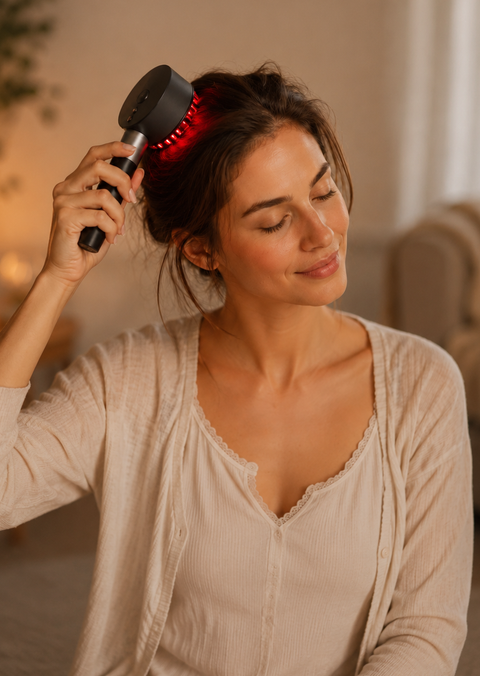
Postpartum Hair Loss: Why It Happens and How Red Light Therapy Helps
If you've recently had a baby and noticed your hair coming out in alarming amounts -- in the shower, on your pillow, in your brush -- you're not imagining it, and you're not alone. Postpartum hair loss affects an estimated 40-50% of new mothers, typically beginning 2-4 months after delivery and peaking around month 4-5.
The good news: it's almost always temporary. The better news: there are things you can do to shorten its duration and support faster regrowth. Red light therapy at 660nm is one of the most evidence-supported options available -- and it's drug-free, non-invasive, and safe for new mothers.
Why Does Postpartum Hair Loss Happen?
To understand postpartum hair loss, you need to understand the hair growth cycle.
Hair follicles cycle continuously through three phases: anagen (active growth), catagen (transition), and telogen (resting/shedding). Under normal conditions, roughly 85-90% of your hair follicles are in the anagen phase at any given time, with only 10-15% in telogen.
During pregnancy, elevated estrogen levels essentially pause the normal cycle. Follicles that would normally transition to telogen and shed stay in the anagen phase instead. This is why many women experience thicker, fuller hair during pregnancy -- you're retaining hair you would normally have shed.
After delivery, estrogen levels drop rapidly. All those follicles that were held in anagen now shift to telogen simultaneously. The result -- called telogen effluvium -- is a wave of shedding that can feel sudden and severe, even though it's actually a delayed, compressed version of normal shedding that was postponed during pregnancy.
Telogen effluvium is not the same as permanent hair loss. The follicles are not damaged or dead -- they're simply in the resting phase. The question is how long they stay there before reactivating.
How Red Light Therapy Addresses Postpartum Hair Loss
This is where 660nm red light therapy becomes directly relevant. The core mechanism -- stimulating mitochondria in follicle cells to produce more ATP (cellular energy) -- is exactly what's needed to move follicles out of the telogen resting phase and back into active anagen growth.
Specifically, red light therapy at 660nm:
- Accelerates the telogen-to-anagen transition: Rather than waiting for follicles to reactivate on their natural timeline (which can take 6-12 months), red light therapy provides the energy stimulus that encourages earlier reactivation
- Extends the anagen phase once it restarts: This means the new hair that grows comes in thicker and stays longer before shedding again
- Reduces scalp inflammation: Postpartum hormonal changes can trigger scalp inflammation that further delays regrowth; 660nm light directly addresses this
- Improves scalp circulation: Better blood flow means follicles receive more of the oxygen and nutrients they need to produce new hair
Clinical research on LLLT for telogen effluvium specifically has shown meaningful reductions in shedding duration and faster visible regrowth compared to no treatment.
Is Red Light Therapy Safe for New Mothers?
Yes. Red light therapy at 660nm is non-invasive and drug-free -- there are no chemicals entering your body, no hormonal effects, and no systemic side effects. It's a localized light treatment applied to the scalp.
For new mothers who are breastfeeding and understandably cautious about anything that could affect their baby, red light therapy is one of the few hair loss interventions that carries zero concern in this regard. Minoxidil (Rogaine), by contrast, is not recommended during breastfeeding.
The only precaution for sensitive scalps: start with 5-minute sessions and build up to the full 10-minute protocol over the first week.
When to Start and What to Expect
The best time to start red light therapy for postpartum hair loss is when you first notice shedding increasing -- typically around months 2-4 postpartum. Starting early means you're supporting follicle reactivation at the point when they're beginning to cycle back naturally, which amplifies the effect.
A realistic timeline:
- Weeks 1-2: Reduced scalp tightness and irritation; some women notice shedding beginning to slow
- Weeks 3-4: Visible reduction in the amount of hair lost during washing and brushing
- Months 2-3: New growth becomes visible, particularly along the hairline and at the temples (the areas typically most affected by postpartum loss)
- Month 3+: Continued thickening and improvement with consistent use
Consistency is the most important factor. Ten minutes daily, at least 5 days per week, is the protocol that matches clinical study parameters.
Combining Red Light Therapy with Other Postpartum Hair Support
Red light therapy works best as part of a broader approach to postpartum recovery:
- Nutrition: Iron, biotin, zinc, and protein are all critical for hair growth and are commonly depleted during and after pregnancy. Continue your prenatal vitamin and focus on iron-rich foods.
- Gentle handling: Avoid tight hairstyles, heat styling, and aggressive brushing during the shedding phase.
- Scalp massage: Improves circulation to follicles -- even more effective when combined with red light therapy in the same session.
- Hair growth serum: The LumaBloom LB-01's built-in serum delivery system lets you apply your chosen hair growth liquid directly to the scalp during your red light session, so the two treatments work simultaneously.
You Don't Have to Wait It Out
The standard advice for postpartum hair loss is to wait -- it will resolve on its own, eventually. And it's true that for most women, shedding does slow and regrowth does happen without intervention.
But 'eventually' can mean 6-12 months of significant shedding. You don't have to accept that timeline passively. Red light therapy gives your follicles the energy they need to reactivate sooner, and the evidence supports using it.
The LumaBloom LB-01 delivers 660nm red light therapy, bionic scalp massage, and precision serum delivery in a single 10-minute daily session. It was designed for exactly this kind of situation: a real biological problem that deserves a real, science-backed solution.