
Red Light Therapy for Hair Loss: Does It Actually Work? (The Science Explained)
If you've spent any time researching hair loss solutions, you've probably come across red light therapy -- and you've probably wondered whether it's real science or just clever marketing. It's a fair question. The wellness industry is full of devices that promise results they can't deliver.
This article is going to give you the honest answer, grounded in how the science actually works. No hype. No inflated claims. Just what the research says and what you can realistically expect.
What Is Red Light Therapy?
Red light therapy -- also called low-level laser therapy (LLLT) or photobiomodulation -- uses specific wavelengths of light to penetrate the skin and stimulate cellular activity. It was originally discovered through NASA research on plant growth in space, where scientists found that red light-emitting diodes dramatically accelerated cellular repair and growth processes.
That discovery led to decades of research into how the same principle applies to human biology. Today, photobiomodulation is one of the most studied non-invasive therapeutic technologies in dermatology and sports medicine.
For hair loss specifically, the relevant wavelength is in the red light range -- particularly around 660 nanometers (nm). This is the wavelength that has been shown to penetrate scalp tissue to the depth where hair follicles live.
Why Does Hair Fall Out in the First Place?
To understand why red light therapy works, you first need to understand why hair stops growing. Hair loss -- regardless of whether it's genetic, stress-related, hormonal, or age-related -- almost always involves one or more of the same three underlying mechanisms:
- Follicle dormancy: Hair follicles cycle through active growth (anagen), transition (catagen), and resting (telogen) phases. When follicles spend too long in the resting phase -- or transition there prematurely -- hair thins and sheds faster than it regrows.
- Poor scalp circulation: Hair follicles need a constant supply of oxygen and nutrients delivered via blood flow. When circulation to the scalp is compromised, follicles become starved and underperform.
- Chronic scalp inflammation: Low-grade inflammation around hair follicles is one of the most underrecognized drivers of hair loss. It damages follicle tissue over time and disrupts the normal growth cycle.
Most conventional hair loss treatments address only one of these. Red light therapy addresses all three simultaneously.
How Does 660nm Light Actually Affect Hair Follicles?
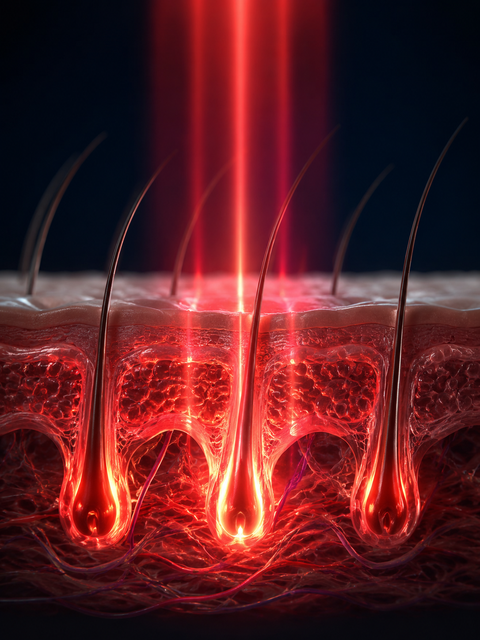
When 660nm red light reaches your scalp, it penetrates approximately 8-10 millimeters into tissue -- deep enough to reach the hair follicles in the dermis layer. Inside those follicles, the light is absorbed by the mitochondria: the tiny energy-producing structures inside every cell.
Mitochondria produce ATP (adenosine triphosphate) -- the molecule that powers virtually every cellular process, including hair growth. When mitochondria absorb red light, their ATP output increases significantly. This energy boost has several downstream effects:
- Dormant follicles shift back into the active growth (anagen) phase
- The anagen phase extends, meaning each hair grows for longer before shedding
- Inflammation around follicles decreases
- Blood flow to the scalp improves, delivering more nutrients to each follicle root
- Collagen production increases, strengthening the scalp tissue that anchors follicles
What Does the Research Actually Show?
The clinical evidence for LLLT and hair growth is substantial. A meta-analysis published in Lasers in Medical Science reviewed 11 randomized controlled trials and concluded that low-level light therapy produced statistically significant improvements in hair count and thickness in both men and women with androgenetic alopecia -- the most common form of genetic hair loss.
Research published in Lasers in Surgery and Medicine confirmed that 660nm light penetrates to the depth of the hair follicle in human tissue. A study in Photomedicine and Laser Surgery found a 39% increase in hair tensile strength in participants using LLLT -- meaning not just more hair, but stronger hair resistant to breakage.
How Does It Compare to Other Hair Loss Treatments?
Minoxidil (Rogaine): Requires continuous use -- stop using it and the hair you gained typically sheds within months. Common side effects include scalp irritation and unwanted facial hair growth.
Finasteride: A prescription medication that blocks DHT. Associated with significant side effects in some users. Not recommended for women of childbearing age.
Hair transplant surgery: Invasive, expensive ($4,000-$15,000+), and requires sufficient donor hair.
Red light therapy (LLLT): Non-invasive, drug-free, no known side effects, no dependency, no rebound shedding when you stop. Works by stimulating the follicle's own biology rather than forcing or blocking a process.
What Results Can You Realistically Expect?
- Weeks 1-2: Reduced scalp tension and irritation.
- Weeks 3-4: Visible reduction in shedding.
- Months 2-3: Meaningful improvements in hair density and thickness.
- Month 3+: Continued improvement with consistent use.
The most important factor is consistency. Using a red light therapy device for 10 minutes daily, at least 5 days per week, is what the clinical protocols recommend.
The Bottom Line
Red light therapy for hair loss is not marketing hype. It is a clinically studied, mechanism-supported approach that addresses the root causes of most types of hair loss in a way that is safe, drug-free, and backed by peer-reviewed science.
The LumaBloom LB-01 was designed specifically to deliver 660nm red light therapy to the scalp alongside bionic massage and precision serum delivery -- the three mechanisms your scalp needs to shift from struggling to thriving.